



CBN, cannabinol, is a mildly psychoactive cannabinoid that forms when THC ages and oxidizes. It is the reason old cannabis behaves differently than fresh cannabis, it is far weaker than THC, and it has become the most talked-about minor cannabinoid in the nighttime product aisle. Here is what CBN actually is, how it forms, what people report from it, and what the research does and does not say, separated honestly.
Key Takeaways
- CBN (cannabinol) forms when THC is exposed to oxygen, heat, and light over time. It is literally aged THC.
- It is mildly psychoactive, with effects commonly described as far gentler than THC, closer to a faint echo than a high.
- High CBN in flower usually signals old or badly stored material; in finished products it is a deliberate, measured ingredient.
- Research on CBN is early and limited. Most of what you read about it online is marketing, not evidence.
- On a COA, CBN is listed with the other cannabinoids, so you can verify exactly how much a product contains before buying.
What is CBN?
Cannabinol, CBN, is one of more than a hundred cannabinoids produced by the cannabis plant, but it has an unusual origin story: the plant barely makes it on purpose. Fresh, well-stored cannabis contains almost none. CBN is instead a breakdown product, the molecule THC turns into as it degrades. That makes CBN less a separate ingredient the plant grows and more a chapter in THC’s life cycle. It was also the first cannabinoid ever isolated, back in the 1890s, decades before anyone identified THC itself, which is a fun piece of trivia with a practical point inside it: scientists found CBN first because aged, oxidized cannabis was what usually reached their labs.
What is CBN in weed? The old-flower connection
When people ask what CBN is doing in their flower, the answer is usually: telling on the storage. THC converts to CBN through exposure to oxygen, heat, and UV light over time, so a high CBN number on flower is the chemical signature of age or bad storage, the cannabis equivalent of a wine turning. A jar left in a hot car or a bag sitting open for a year will test higher in CBN and lower in THC than the day it was packaged. That is why serious producers store material cold, dark, and sealed, and why the CBN line on a certificate of analysis is worth a glance even if you have never heard of the compound: on flower it is a freshness indicator. In a finished product like a gummy, the logic flips entirely. There, CBN is not an accident of storage but a deliberate, measured ingredient, isolated and added at a specific milligram dose.
What does CBN feel like?
CBN is mildly psychoactive, which separates it from CBD, but the operative word is mildly. The commonly cited estimate is that it binds the CB1 receptor at a fraction of THC’s strength, and user reports track with that: most people describe little to no high from CBN at typical product doses, more a sense of winding down than any ceiling-staring event. It is most often used in the evening, usually combined with CBD and sometimes with a small amount of THC, and the experience people describe is quiet. Two honesty notes belong here. First, individual responses vary, and a few people report feeling CBN more strongly than the averages suggest, particularly in combination products. Second, the dramatic effects attributed to CBN in marketing copy, and there is a lot of marketing copy, are far ahead of anything the evidence currently supports.
What the research actually says
Here is the part most CBN articles skip, because it is inconvenient for selling CBN: the research is early, thin, and mixed. The famous claim that CBN is sedating traces heavily to a handful of small studies from the 1970s, some involving only a few participants, mostly testing CBN combined with THC rather than alone. Modern studies are only now beginning to examine CBN by itself, and their results so far are modest and preliminary. That does not make CBN products pointless, and it does not contradict what individual users report; it means the honest summary is that science has not caught up to the marketing. We would rather tell you that plainly than borrow a claim we cannot back. If you want the deeper dive on the sleep-product question specifically, we wrote about it in do CBN gummies help sleep, with the same no-overpromising rule applied.
CBN vs THC vs CBD at a glance
| THC | CBN | CBD | |
|---|---|---|---|
| Psychoactive? | Yes, strongly | Mildly | No high |
| Where it comes from | Made by the plant (via THCA) | Forms as THC ages and oxidizes | Made by the plant (via CBDA) |
| Typical use | Daytime or evening, effects-driven | Evening formulas, usually blended | Any time, non-intoxicating |
| Legal basis (hemp) | Capped at 0.3% Delta-9 by weight | Hemp-derived, sold under hemp law | Hemp-derived, sold under hemp law |
Legal summary reflects federal law in force as of October 2026; state rules vary. Check your state and the product COA.
CBN vs CBD: the short version
They get confused constantly because the names rhyme, but they are different molecules doing different jobs. CBD is non-intoxicating, produced abundantly by the plant on purpose, and sold in everything from tinctures to topicals. CBN is mildly psychoactive, produced mostly by degradation, and shows up almost exclusively in evening-oriented blends. The full comparison has its own guide: CBD vs CBN, what you need to know.
How CBN products are actually made
Nobody fills a gummy by waiting for flower to get old. Commercial CBN is produced deliberately: hemp-derived cannabinoids are converted and refined into CBN isolate, a purified crystalline form, which is then dosed into finished products at exact milligram amounts. That precision is the entire advantage of a manufactured product over the old-flower accident: a blend can deliver, say, a fixed dose of CBD alongside a fixed dose of CBN in every piece, batch after batch. It also means the quality question reduces, as it always does, to the lab report. A real CBN product shows the CBN number on a batch-specific COA from an independent lab, alongside the full cannabinoid and contaminant panels. Ours are published for every batch on the Lab Results page, and our guide to reading third-party lab tests shows where the CBN line lives on the report.
Is CBN legal?
Federally, hemp-derived CBN is sold under the 2018 Farm Bill framework today: products made from compliant hemp with no more than 0.3% Delta-9 THC by dry weight. CBN itself is not separately scheduled at the federal level. States layer their own rules on hemp products, and policy in this space continues to evolve, so the practical advice is the same as for any cannabinoid product: check your state’s current rules, and check the COA so you know exactly what is in the package. Our state-by-state THCA legality guide covers how state hemp rules work in general, and most of that framework applies to any hemp-derived product.
Where CBN fits in a nighttime routine
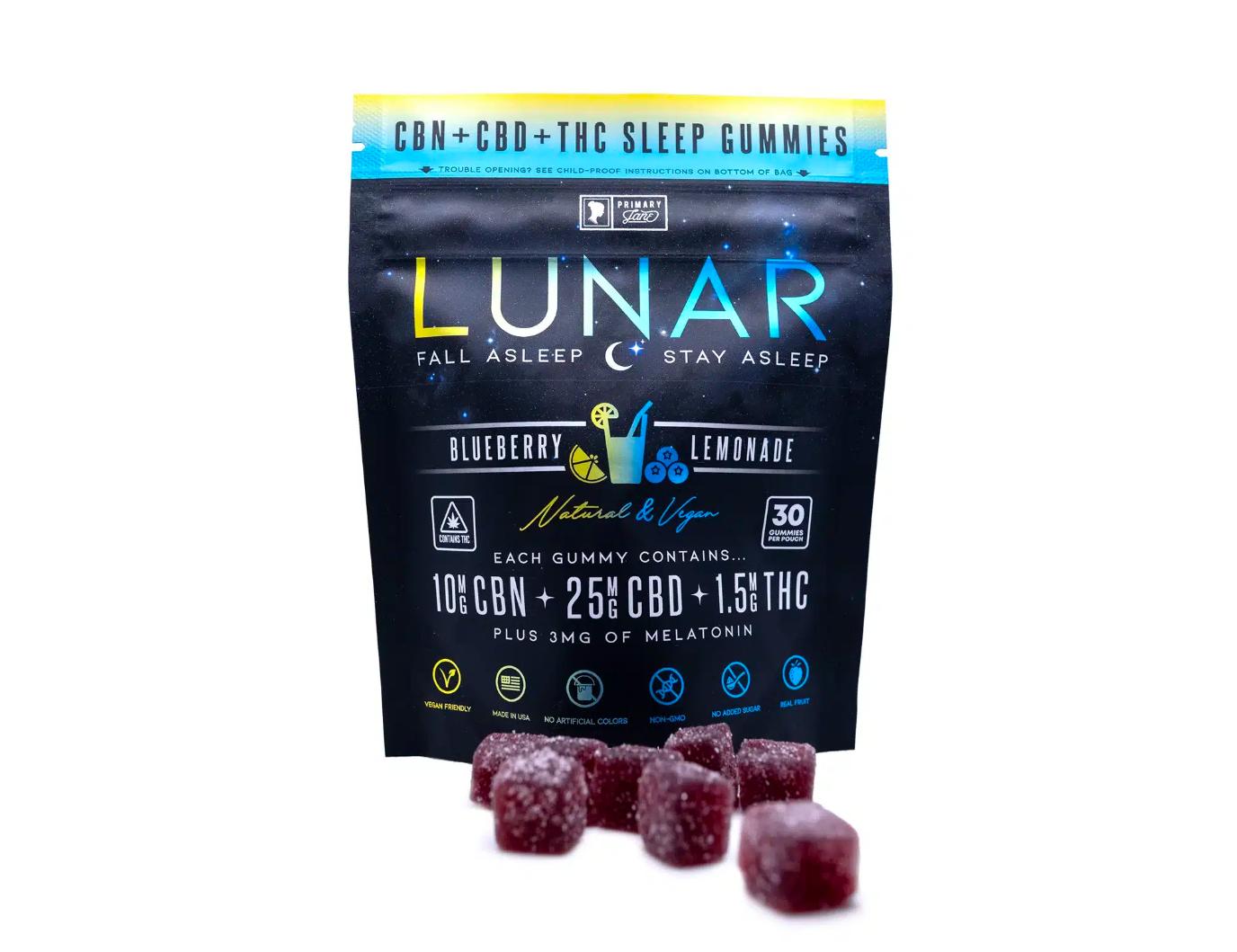
The honest pitch for CBN is modest and real: it is a gentle, measurable, hemp-derived cannabinoid that many people choose as part of an evening wind-down, usually blended with CBD. Our LUNAR CBD + CBN gummies pair the two in a fixed per-gummy dose, lab tested batch by batch, with the COA a scan away. We make no promises about what CBN will do for you, because nobody honestly can; what we can promise is that the milligrams on the label are the milligrams in the gummy, verified by an independent lab. In this category, that is rarer than it should be.
FAQ
Does CBN get you high?
Mildly, at most. CBN is psychoactive but much weaker than THC, and at the doses found in most products, the large majority of people report little to no high. Individual responses vary, especially in blends that also contain THC.
What is CBN in weed?
On flower, CBN is mostly an age marker: it forms as THC oxidizes with time, heat, and light, so high CBN usually means old or poorly stored material. In finished products, it is a deliberately added, precisely dosed ingredient.
Is CBN just old THC?
Chemically, essentially yes: CBN is the main product of THC degradation. But commercial CBN is made deliberately from hemp and purified into isolate, not scraped from old flower, so a CBN gummy is a precise product, not a stale one.
Does CBN help you sleep?
The research is early, small, and mixed, and we do not make sleep claims for any product. Many people include CBN in their evening routine and report it fits well there; whether it does for you is something no brand can promise. Our CBN gummies article covers the evidence in detail.
Will CBN show up on a drug test?
CBN itself is not what standard panels screen for, but some research suggests it can interfere with certain immunoassay screens, and CBN products that contain trace THC carry the same consideration as any hemp product. If testing matters to you, read our drug testing guides and check every COA.
0 Comments